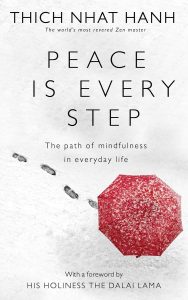
Thich Nhat Hanh ~ Peace is Every Step
Praise from Contemporary Spiritual Teachers for Thic Nhat Hanh
Thich Nhat Hanh (often affectionately called Thây, or “Teacher”) is widely regarded across traditions as one of the foundational figures who brought mindfulness and “Socially Engaged Buddhism” to the modern world.
Living teachers and contemplative leaders frequently highlight how he bridged deep monastic practice with everyday action:
- His Holiness the Dalai Lama (Foreword to the book)“This is a very worthwhile book. It can change individual lives and the life of our society.”
- Roshi Joan Halifax (Zen Master & Abbot of Upaya Zen Center)“Thay taught me that being a social activist is not separate from being a contemplative. Thanks to him, untold numbers of us opened our lives to the path of socially engaged Buddhism.”
- Father Richard Rohr (Franciscan Friar & Founder of the Center for Action and Contemplation)“He was one of the first people who helped me grapple with what mindfulness really meant. Many teachers try to focus on letting go of the mind. That’s such a daunting concept. But he emphasized mind-full-ness. These teachings had so many simple yet profound implications. They weren’t highly philosophical or abstract—rather grounded in reality.”
- Jack Kornfield (Buddhist Teacher & Co-founder of Spirit Rock Meditation Center)“In a magnificent way, Thich Nhat Hanh became that steady and wise one, showing the way for us all… Thich Nhat Hanh’s instruction was to stop—stop making enemies. Make prayers. Make blessings. This is our moral task.”
The book’s primary mindfulness exercises fall into three practical categories:
1. Anchoring in the Present Moment
- Conscious Breathing (Gathas): Using short, silent poetic verses synchronized with the breath to tether a wandering mind to the body. The foundational exercise is simply noticing the breath without trying to force it:“Breathing in, I calm my body. Breathing out, I smile. Dwelling in the present moment, I know this is a wonderful moment.”
- Half-Smiling: Gently relaxing the facial muscles into a subtle, effortless half-smile—even when feeling irritated or neutral. Thich Nhat Hanh notes that just as joy produces a smile, a physical half-smile signals the nervous system to release tension and cultivate serenity.
- Walking Meditation: Walking not to arrive at a destination, but to enjoy each step. You synchronize your breath with your footsteps (for example, taking three steps on an in-breath and three on an out-breath), imagining your feet gently kissing the earth rather than rushing across it.
2. Transforming Mundane Chores into Meditation
- Washing Dishes to Wash Dishes: Treating household tasks as the main event rather than an obstacle between you and “free time.” If you rush through washing the dishes just to get to your cup of tea, you miss both the dishwashing and the tea because your mind is always pulled toward the next moment.
- The “Bell of Mindfulness”: Turning everyday interruptions—a ringing telephone, a chiming clock, or a red traffic light—into triggers to pause. Instead of immediately reaching for the phone or feeling frustrated in traffic, you take three conscious breaths before acting.
- Mindful Eating: Eating in silence for the first few minutes of a meal, chewing slowly, and looking deeply at the food to recognize the interconnected elements (“Interbeing”)—sunshine, rain, earth, and human labor—that brought it to your plate.
3. Working with Difficult Emotions & Relationships
- Caring for Anger (Not Fighting It): Rather than suppressing anger or venting it destructively, Thich Nhat Hanh compares anger to a crying baby. You acknowledge it tenderly through mindful breathing (“Breathing in, I know anger is in me; breathing out, I am taking good care of my anger”), holding it with compassion until the energy naturally subsides.
- Hugging Meditation: A structured practice for reconciling or deepening connection with loved ones. Two people bow, embrace, and take three slow, deep breaths together:
- First breath: Become aware that you are alive in the present moment.
- Second breath: Become aware that the other person is alive and present with you.
- Third breath: Feel gratitude that you are both here together right now.
- Deep Listening & Loving Speech: Listening to another person’s pain with the sole intention of helping them suffer less—without interrupting, judging, or correcting them—and speaking only words that inspire confidence, joy, and understanding.
This is one of the books you will return to again again, as I have done, to support and guide you in every step and stage of life.

Affiliate link (Ad)
We earn commission from
qualifying purchases.
Lucidly and beautifully written, PEACE IS EVERY STEP contains commentaries and meditations, personal anecdotes and stories from Nhat Hanh’s experiences as a peace activist, teacher, and community leader. It begins where the reader already is – in the kitchen, office, driving a car, walking in a park – and shows how deep meditative presence is available now. Nhat Hanh provides exercises to increase our awareness of our own body and mind through conscious breathing, which can bring immediate joy and peace. Nhat Hanh also shows how to be aware of relationships with others and of the world around us, its beauty and also its pollution and injustices. The deceptively simple practices of PEACE IN EVERY STEP encourage the reader to work for peace in the world as he or she continues to work on sustaining inner peace by turning the ‘mindness’ into the mindful.
We are very happy to recommend it.
Buy Peace is Every Step on Amazon →
Affiliate link — if you make a qualifying purchase through this link, Hamblin Vision Publishing may receive a small commission at no additional cost to you.
The New Hamblin Editions


Find us on Social Media
YouTube