Philip Pegler’s Journey into the Hamblin Legacy
In the library of an Indian ashram, a young English pilgrim discovered a Sussex connection that would shape his spiritual and literary life for decades to come.
In the autumn of 1970, Philip Pegler set out alone on a pilgrimage through India. It was a journey undertaken in an era before mass tourism and rapid modernisation had transformed much of the country: a time when travel could still unfold slowly, unpredictably and with a certain simplicity.
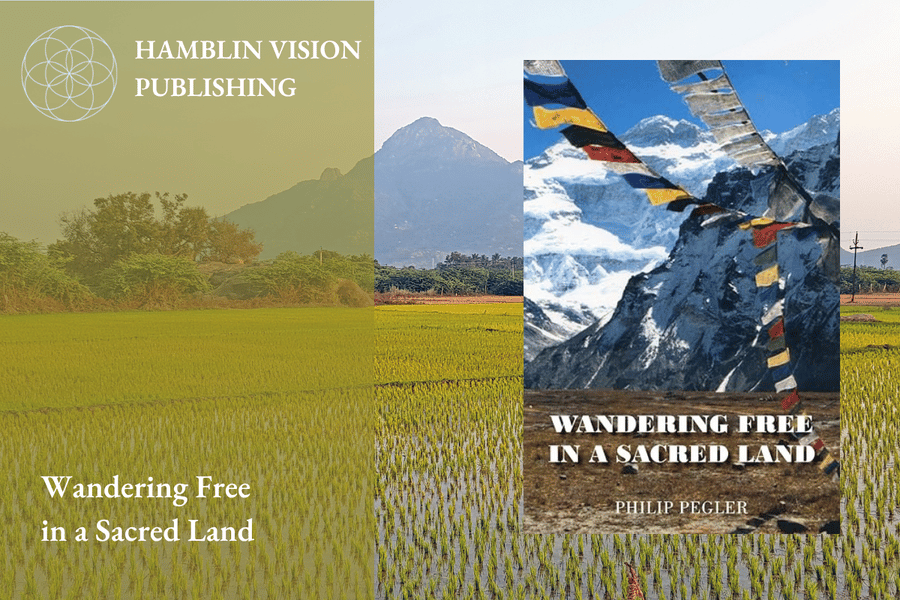
More than fifty years later, Philip returned to the journals he had kept during those travels. The result is Wandering Free in a Sacred Land: Finding Firm Faith in Bygone India, a vivid and richly illustrated account of an outward journey that gradually became an inward one.
The book carries us through sacred places, unexpected encounters and moments of profound insight. Yet one of its most remarkable discoveries occurred not on a mountain path or beside a temple, but in a library.
A Sussex Connection in Southern India
During his pilgrimage, Philip visited Sri Ramanasramam at Arunachala, the ashram associated with the great Indian sage Ramana Maharshi. Although Maharshi had died in 1950, the ashram continued to draw spiritual seekers from India and the West.
There, among the books and periodicals in its library, Philip came across a copy of The Science of Thought Review. Edited by Clare Cameron, the periodical had its origins in the work of Henry Thomas Hamblin and was produced at Bosham House in Sussex.
Philip could hardly have expected to find, thousands of miles from home, a publication devoted to a more esoteric understanding of spirituality that had been created only a few miles from where he himself lived.
That small detail—the address at Bosham—remained with him. On his return to England, Philip made the journey across the South Downs to meet Clare Cameron. An immediate and deep affinity developed between them, beginning a lifelong friendship rooted in their shared spiritual understanding.
Through Clare, Philip’s connection with Hamblin’s legacy deepened. He found lasting sustenance in Mr Hamblin’s writings and later contributed to New Vision, the magazine that continued the work of The Science of Thought Review. What began as the chance discovery of a periodical in an Indian ashram became a continuing thread through Philip’s spiritual and literary life.
The Inner Country
At the heart of Wandering Free in a Sacred Land lies the recognition that the deepest pilgrimage is not finally towards a distant country, teacher or sacred place. Authentic wisdom must be discovered within our own conscious awareness.
India provided Philip with the landscape of the journey, but its true destination lay deeper. Through the places he visited and the people he encountered, he was drawn towards a firmer faith in the truth that spiritual reality is not separate from us. It is found in the attentive meeting with life itself—in stillness, in beauty and in the commonplace.
This understanding has continued through Philip’s subsequent writing, including Hidden Beauty of the Commonplace, Meeting Evil with Mercy and Quiet Courage of the Inner Light.
I first met Philip in 2010 through our mutual appreciation of the contemporary English spiritual teacher and author Jeff Foster. Philip had written the foreword to Jeff’s book An Extraordinary Absence, which prompted me to contact him. I later attended a weekend retreat with Jeff at the Midhurst home Philip shares with his wife, Wendy.
Since then, Philip has told me many times the story of discovering The Science of Thought Review at Arunachala. It is one of those stories that seems to contain its own quiet pattern: a young Englishman travels across the world in search of spiritual truth, only to discover a path leading him back across the Sussex Downs.
Philip has remained a personal friend and a longstanding supporter of our work at Hamblin Vision. Indeed, I owe my own association with Hamblin—and the work I now do at Hamblin Vision Publishing—to him. In 2012, while helping Philip to build his website and launch his first book at Hamblin Hall, I made my first connections with the Hamblin Trust and the Hamblin Centre team.
It is therefore a particular pleasure to feature Wandering Free in a Sacred Land here.
The book is not only a record of bygone India. It is also the story of how one journey can continue unfolding through a lifetime, intertwining with the journeys of others—and how a chance encounter with a small Sussex periodical, found halfway across the world, can open the door to an enduring spiritual friendship.

Affiliate link (Ad)
We earn commission from
qualifying purchases.
Written with warmth, curiosity and humility, it is a reflective account of what can happen when travel becomes more than movement from place to place — when it becomes a way of listening, questioning and discovering.
For readers drawn to pilgrimage, contemplative spirituality and the meeting of Eastern and Western traditions, this is a thoughtful and quietly rewarding book.
We are very happy to recommend it.
Buy Wandering Free in a Sacred Land on Amazon →
Affiliate link — if you make a qualifying purchase through this link, Hamblin Vision Publishing may receive a small commission at no additional cost to you.
The New Hamblin Editions


Find us on Social Media
YouTube